RFID and AI Optimization: Where the Combination Actually Helps

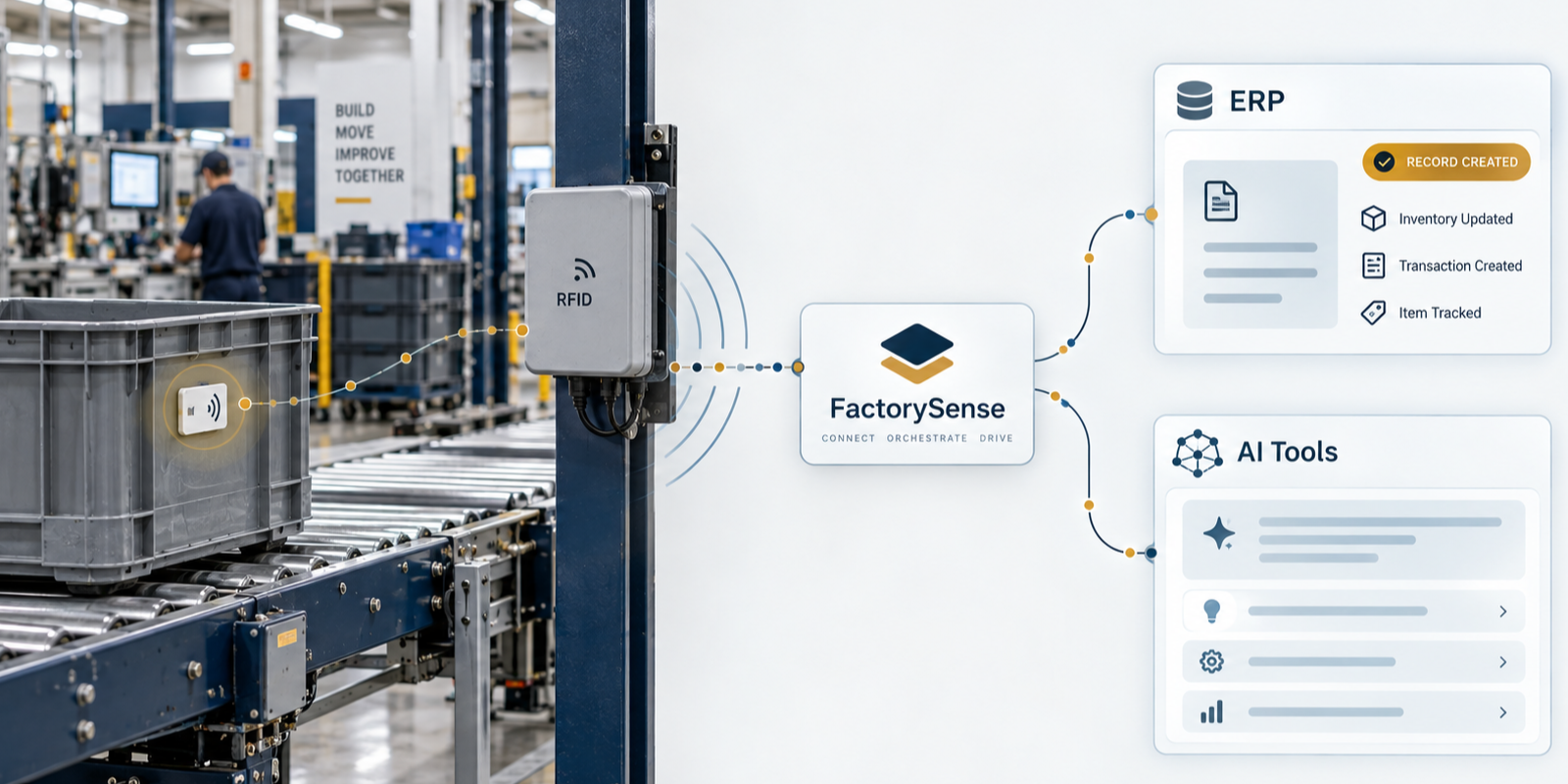
- RFID should establish trustworthy physical events before AI is asked to optimize from them.
- Inventory, asset and WIP use cases benefit most when the analytical question maps to a decision the operation can actually make.
- Exception prioritization and human-supervised recommendations are often a more practical first AI step than autonomous control.
RFID and AI are often presented as a combined technology package. In practice, they solve different problems. RFID can improve the evidence about what is physically happening. AI and statistical methods can help decide what deserves attention once that evidence is available.
That distinction is useful because it keeps the business case grounded. If a warehouse does not know where inventory is, the first problem is visibility. If the warehouse already has reliable inventory events but struggles to prioritize replenishment, exceptions or labor, an analytical layer may help. Combining the two can be powerful, but only when each layer is solving a problem that actually exists.
Manufacturers are seeing AI value, but scaling remains difficult
Deloitte's 2026 AI in Manufacturing survey, based on more than 140 manufacturing organizations, found that 84% of respondents report measurable value from AI in operations. At the same time, only about one in five use cases has been scaled consistently across sites or enterprise-wide. Deloitte also found that adoption is concentrated in data-rich, KPI-critical areas, with logistics and supply chain among the leading domains.
Deloitte’s 2026 research on AI in manufacturing points to an important gap between creating value and achieving scale. Among more than 140 manufacturing organizations surveyed, 84% reported measurable value from AI in operations, yet only about 20% of AI use cases had been scaled consistently across sites or enterprise-wide. In other words, manufacturers are often seeing meaningful results before they have succeeded in deploying those capabilities broadly. Source: Deloitte, AI in Manufacturing 2026.
The lesson is relevant to RFID projects because scaling AI requires a repeatable data and operating model, not just a successful demonstration. An AI use case that depends on inconsistent physical data will be even harder to repeat across plants.
Inventory: use AI after the record is trustworthy
Inventory is an obvious area for optimization because the organization already makes decisions about reorder points, allocation, safety stock, aging and exceptions. RFID can help where the physical count and the system count diverge because movements are not captured reliably.
Once the event history is trustworthy, analytical models can help prioritize discrepancies, identify unusual consumption patterns or estimate short-term risk. The AI layer is not there to compensate for a broken inventory process. It is there to extract more value from a record the business already trusts.
MIT Center for Transportation & Logistics' 2026 omnichannel research found AI impact reported in inventory management by 60% of respondents and in warehouse management by 61%. That research is focused on omnichannel supply chains rather than industrial RFID, but it reinforces that inventory and warehouse operations are becoming major AI application areas. The MIT CTL findings are available here.
Our inventory-management guide covers the underlying RFID problem without assuming an AI component.
Assets: distinguish location, utilization and condition
An RFID history can tell us that an asset was observed in a particular place or moved through a controlled point. That is different from utilization. A machine may be present and idle; a tool may be moving frequently but only because it is being searched for; a calibrated asset may be physically available but not eligible for use.
AI can help when several data streams are combined: movement, maintenance, work orders, calibration and perhaps sensor information. The useful output might be a prioritized list of assets whose movement pattern is unusual, equipment that appears underused, or items at risk of being unavailable for an upcoming job.
Those recommendations should remain tied to the underlying evidence. If the RFID coverage is incomplete, the model should not present inferred location as observed fact.
For the non-AI version of the asset problem, see our RFID asset-tracking guide.
Work-in-process: focus on dwell and flow
WIP creates a useful analytical dataset when transitions are captured consistently. The event history can show how long jobs spend between operations, where queues form, which routings generate repeated rework and which product families behave differently from the plan.
Some of that analysis does not require AI at all. Basic statistics and process control may answer the question. AI becomes more relevant where there are many interacting variables, irregular patterns or a need to rank exceptions dynamically.
The practical advantage of RFID is that the transition history can be captured with less manual intervention. Our WIP article explains the process-design side of that problem.
Exception management is often a better first AI use case than autonomy
Industrial teams do not need to begin by allowing a model to move inventory, release work or change schedules automatically. A lower-risk starting point is exception prioritization.
The analytical layer can review event patterns and identify the conditions most worth a person's attention: a pallet dwelling unusually long, an asset appearing in an unexpected zone, a material flow that departs from normal routing, or a count discrepancy that is likely to affect production soon.
This keeps the human decision visible while the organization learns where the model is reliable. It also produces a useful feedback loop: operators can confirm or reject the recommendation, creating better labels for future analysis.
Use a normalized event layer
Raw RFID observations are not an ideal input for analytical systems. Readers can see the same tag repeatedly, and individual antenna observations may have no business meaning. The software layer should resolve identity, filter duplicate observations and produce events such as received, moved, staged or returned.
GS1 EPCIS provides an established visibility-event model for expressing what happened, when and where it happened, and the business context. Even when an organization does not implement EPCIS directly, the separation between capture data and business-event data is a useful architecture principle.
Our integration guide covers that layer in more detail.
Do not optimize what the operation cannot change
A model can correctly identify a bottleneck and still create no value if the plant has no practical way to change it. The same is true of inventory, asset allocation and maintenance. The analytical question should therefore be tied to a decision the organization can actually make.
That is why we prefer use cases framed as: “Which exceptions should the planner review first?” “Which assets are likely to be unavailable for this job?” “Which WIP items have an unusual dwell pattern?” Those questions have a clear owner who will benefit from the automation, and a clear set of actions that can be automated with RFID.
Generic promises such as “AI will reduce inventory” or “AI will eliminate shrink” skip the mechanism between insight and outcome.
Measure value at the operating metric
The value of RFID plus AI should be measured where the process changes, not in the number of model predictions or tag reads. Depending on the use case, that might mean fewer hours spent searching, lower reconciliation effort, faster exception resolution, reduced WIP dwell, fewer stockouts or better asset availability.
Deloitte's survey shows that manufacturers are already finding measurable AI value, but it also shows how hard it is to scale. A local result should therefore be treated as evidence for a use case, not proof that the same economics will repeat everywhere.
Our RFID ROI guide describes the baseline-and-measurement approach we use before attributing savings to technology.
Build the data pipeline before the AI pipeline
A sensible implementation sequence is to prove the physical event first, integrate it into normal operations, then add the analytical layer. NIST's 2026 smart-manufacturing AI roadmap identifies industrial data management, heterogeneous sensing and trustworthy operation as foundational challenges, which is consistent with this sequence.
RFID and AI operational decision loopA conceptual diagram showing physical events captured by RFID, converted to normalized events, analyzed for patterns and exceptions, reviewed or acted upon, and measured against an operating outcome.A practical RFID + AI loopCaptureRFID observes aphysical eventContextidentity + process+ system stateAnalyzepatterns, riskor exceptionsDecidehuman reviewor controlled actionMeasuredid the operatingmetric improve?AI belongs after the physical event has enough context to support a real decision.FactorySense conceptual illustration. Not every use case requires AI; rules or conventional analytics may be sufficient.
The implementation should then test whether the analytical method is better than the existing decision process. If not, the organization still has improved operational visibility from the RFID layer. If it is better, there is a defensible reason to scale the AI use case.
The useful combination is selective, not universal
RFID and AI fit together when an operation needs better physical-event data and has a specific analytical decision that benefits from that data. That is a narrower claim than saying the technologies “revolutionize” supply chains, but it is also more actionable.
Start with the operating problem. Improve the event data only where the current record is not good enough. Then apply AI where the added analysis changes a decision the business can measure. In our experience, that sequence produces much more credible projects than beginning with the technologies and searching for a reason to combine them.
What can AI do with RFID data?
Once RFID observations are converted into trustworthy business events, AI or statistical models can help detect anomalies, prioritize exceptions, identify dwell patterns, estimate risk and support forecasting or allocation decisions.
Does RFID plus AI automatically improve inventory accuracy?
No. RFID can improve the capture of physical inventory events, but accuracy also depends on tag performance, event logic, process design and integration. AI is useful only after that foundation is reliable.
Should manufacturers automate decisions immediately?
Usually not. Exception ranking and human-supervised recommendations are useful starting points because they allow the organization to validate model behavior before permitting automated actions.
Schedule a complementary working session with an RFID professional to discuss your floor or yard, your systems of record, and where the visibility gap between them is costing you.
Book a session